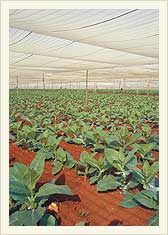
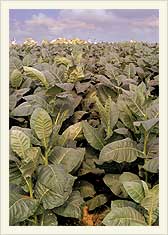
Cigar Production
Production methods and processes are as follows:
Unpacking
Unpacking involves carefully unpacking and moistening of the leaf to avoid damage, especially to the
wrapper leaf. This is done in special airing rooms.
Blending
Master Blenders in each factory order tobacco from the central warehouses according to their production schedule. They select tobacco based not only on its basic classifications (volado, seco, ligero etc), but also on the specific areas that it originated from and on other qualities that will make up the unique characteristics of a cigar.
The details of what specifically goes into these blends are only known to the Master Blenders.
On the day that the cigars are to be rolled, the Master Blender will prepare the tobacco into bundles with the correct amount of each leaf to make a batch of cigars. The rollers will be given a bundle of leaves, along with a basic recipe of percentages of volado, seco and ligero.
Small gauge cigars with a ring size of less than 36, do not contain any Ligero leaf.
Handmade Cigars - Totalmente a Mano Tripa Larga (long filler)
For fully handmade cigars, the roller (Torcedora) first lays out a binder leaf. This will be a light-to-no flavoured leaf - often a rejected wrapper leaf, or volado leaf.
The roller then gathers a bunch of full size (Tripa Larga) filler leaves, folds and rolls them into a tube.
The leaves are arranged with the lighter flavoured tips at the foot of the cigar.
The stronger flavoured slower burning Ligero leaf is placed along the centre of the cigar.
The bunch is then formed by rolling the filler onto the laid-out binder leaf, starting at the foot.
The head of the bunch is guillotined and the bunch is pressed into a timber mould to form the shape of the cigar.
After this stage, the bunches are subject to a suction draw test.
This testing commenced circa 2002; initially only random cigars were suction tested for minimum draw pressure.
Now every cigar undergoes a suction test to satisfy both minimum and maximum draw pressures.
The wrapper is then prepared, smooth side out.
After trimming the exposed edge, the formed bunch is laid on the wrapper and rolled, starting at the cigar's foot.
A small piece is cut from leftover wrapper to form a cap, which is glued over the head of the cigar. The finished cigar is then guillotined to length.
Handmade Short-Filler Cigars - Totalmente a Mano Tripa Corta
Handmade Short Filler cigars have a filler composed of leaf trimmings
from the bunches of long filler cigars combined with other selected chopped tobacco, but full-size binders and wrappers are used. Some short-filler cigars are still produced by Habanos S.A.
Machine-made Cigars - Mecanizado
Machine-made cigars were produced from the 1950s and were made with either long or short filler tobacco.
They could be produced in large quantities and were significantly cheaper than hand-made cigars.
Almost all machine-made cigars were once produced in both fully machine-made and hand-finished versions.
There was a significant phasing out of machine-made cigars between 2002 and 2005.
By 2006, no machine-made cigars remained in the Habanos S.A. range. They are still produced in Cuba by Internacional Cubana de Tabacos S.A., but are no longer classified as Habanos.
Hand-Finished Cigars
Machine-bunched hand-finished cigar had the filler and binder bunched by machine but the wrapper was applied by hand.
Hand finishing of machine bunched cigars (by the hand application of the wrapper) was reduced in the 1990s
and was fully phased out by circa 2002.
Small Cigars
Small cigars are machine-made cigars that weigh less than 3 grams and use short filler tobacco.
They are available in some Cuban cigar brand names. This range includes the Mini, Club, Puritos, and Shorts.
Before circa 2001, they were produced outside Cuba using 100% Cuban Tobacco.
Since then they have been produced in Cuba and therefore can be legally called Cuban cigars, however, they do not meet the D.O.P. standard to be classified as Habanos.
In circa 2005 mini cigars were taken out of the Habanos range, and are now produced by Internacional Cubana de Tabacos, S.A..
Cigarettes
Cigarettes made from Cuban tobacco are available in some Cuban cigar brand names.
Cigarettes are not listed in this website.
Fumigation and Conditioning
Before packing, the cigars are fumigated with Phosphine (Phosphorus
Hydride) to control the tobacco beetle Serricorne, and then conditioned in bundles in cedar lined
cabinets, to reduce and stabilise their moisture.
These cabinets are maintained between 16°C - 18°C and 65% - 70% RH.
Quality control is provided by testing and supervision during the rolling, and
later by both non-destructive and destructive testing.
The supervisors are expert rollers, who are mainly involved in
checking technique, construction and physical cigar sizes at the rolling tables.
Each cigar must pass a suction draw test before the wrapper is applied.
After leaving the roller, the cigars go to the quality control
section, where each cigar is checked for weight, length, ring size,
consistency, construction and appearance.
Samples are also opened up to check internal filler construction, arrangement, and blending of the leaf.
Finally, a sample of the cigars are test-smoked to ensure that they
are consistent with the required character of the vitola.
They are graded for draw, burn, aroma, flavour, strength, and overall quality.
In addition to fumigation, freezing of the finished cigars is used to
kill the tobacco beetle Lasioderma serricorne.
Freezing of cigars commenced around early 2005.
It is carried out in the Habanos main temperature and humidity controlled storage and distribution facility in Guanabacoa.
This, combined with fumigation, is intended to kill all eggs, insects, and lava within the tobacco.
Some regional distributors had their own freezing facilities, predating the Habanos plant.
Details of the Tobacco Beetle and other Pests
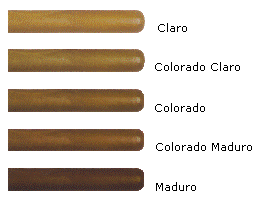
Wrappers have a basic colour classification as shown.
There are many shades within each basis colour. As far as possible, cigars
of the same shade are allocated to a single box.
When there is a slight difference, the shades are arranged
to run from darker to lighter, from left to right across the box.
Construction Issues
Poor Draw - Plugged and Underfilled Cigars
Poor draw problems result from underfilled or overfilled cigars, or
badly bunched or twisted filler leaf within the cigar.
Poor draw can be more pronounced in young, inadequately aged cigars.
Allowing a longer time for the cigar to age may help.
Plugged cigars can vary from partial (hard to draw) to fully plugged (totally unsmokable).
A tight or badly bunched cigar might be saved by poking a thin skewer down the centre of the cigar.
Allowing the cigars to dry (for example by leaving outside a humidor for a few days before smoking, or briefly placing in a refrigerator or freezer) may also help.
Underfilled cigars, while smokable, are very unsatisfying.
There is nothing you can do with an underfilled cigar, except that if the
cigars were over-dry, restoring them to their proper humidity level may help.
Plugged cigars were virtually unheard of before circa 1996.
Construction issues began to appear in 1998, and 2003-2004 was notorious for construction problems,
including gross underfilling.
The situation improved mid-2004.
Since 2005, suction tests are carried out on all cigars before the wrappers are applied.
Today, construction is generally very good.